Affiliate Disclosure: This post may include affiliate links. If you click and make a purchase, I may earn a small commission at no extra cost to you.
Western Digital is reportedly fully allocated on its hard disk drive (HDD) production capacity for 2026, as demand from AI infrastructure and hyperscale data centers continues to surge.
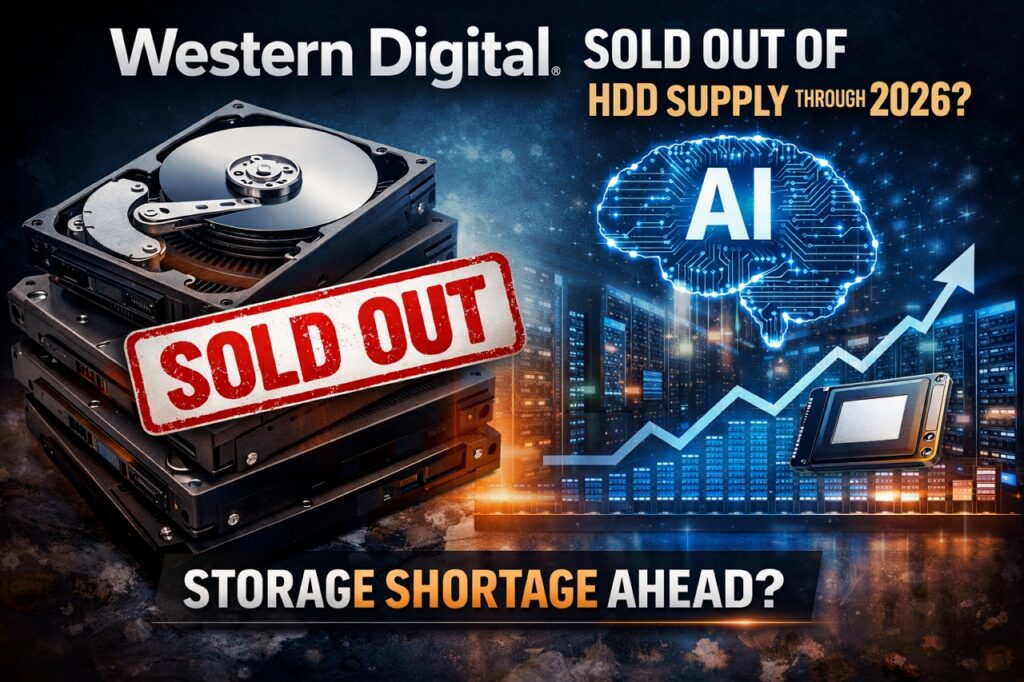
While no formal public statement confirms a complete sellout, multiple industry signals suggest that a significant portion of enterprise HDD output has already been locked in through long-term contracts, leaving limited flexibility for spot markets and smaller buyers.
If accurate, this marks a notable shift in how storage capacity is produced, sold, and consumed.
AI Infrastructure Is Driving Unprecedented Storage Demand
At the center of this shift is the rapid expansion of AI workloads. Hyperscale cloud providers such as Amazon Web Services, Microsoft Azure, and Google Cloud are scaling infrastructure to support:
- Large language model (LLM) training
- Massive dataset storage
- Long-term data retention and compliance
Despite advances in flash storage, HDDs remain critical for high-capacity, cost-efficient storage tiers, especially for cold and archival data.
Nearline HDDs (20TB+) Are the Real Bottleneck
The pressure is most visible in the nearline HDD segment, typically ranging from 18TB to 26TB and beyond. These drives are widely used in:
- Data lakes
- Backup systems
- Object storage platforms
Compared to consumer drives, nearline HDDs:
- Require more advanced manufacturing (e.g., HAMR/MAMR technologies)
- Go through stricter validation cycles
- Are primarily sold via enterprise contracts
Competitors like Seagate Technology are facing similar dynamics, suggesting this is an industry-wide constraint rather than a single-vendor issue.
A Shift Toward Contract-First Storage Allocation
One of the most important changes is not just demand, but how supply is allocated.
Industry observers point to a transition toward a contract-first model, where:
- Hyperscalers secure multi-year supply agreements
- Capacity is pre-allocated far in advance
- Open-market availability becomes secondary
This means that “sold out” may not reflect empty warehouses—but rather fully committed production pipelines.
Pricing Outlook – Stability or Upward Pressure?
With supply increasingly locked in, pricing dynamics are likely to shift:
- High-capacity HDDs (20TB+) may see firm or rising prices
- Spot pricing could become more volatile
- Discounts for smaller buyers may diminish
Historically, HDD pricing has been cyclical, but AI-driven demand introduces a more structural, less elastic factor into the equation.
SSD Vendors Positioned to Capture Spillover Demand
As HDD supply tightens, SSD vendors may benefit from incremental demand. Companies such as Samsung Electronics, Micron Technology, and SK hynix are continuing to expand NAND production and push higher-density solutions.
However, the substitution is not straightforward: SSDs excel in performance, but HDDs still dominate in cost per terabyte, especially at hyperscale.
This suggests coexistence rather than immediate replacement.
What We’re Hearing (Industry Signals & Market Sentiment)
While official confirmation remains limited, several signals reinforce the narrative:
- Enterprise procurement cycles are getting longer
- Channel partners report tighter availability for high-capacity drives
- Discussions across tech communities suggest growing concern about supply constraints
On forums like Reddit and industry threads, users are already asking:
- “Should I buy HDDs now before prices go up?”
- “Are cloud companies locking everyone else out of supply?”
These discussions highlight a growing awareness that storage availability—not just pricing—may become a key concern.
Impact Across Different Segments
Enterprise & Cloud
- Longer lead times
- Increased reliance on contracts
- More predictable but less flexible supply
SMB & IT Professionals
- Potential difficulty sourcing high-capacity drives
- Reduced pricing leverage
Consumers & Enthusiasts
- Retail supply likely remains available
- But selection and pricing may fluctuate
HDD vs SSD – A Real Inflection Point?
This development raises a broader question: Are we approaching a tipping point in the storage market?
While HDDs continue to dominate bulk storage, several trends are converging:
- SSD costs are gradually declining
- AI workloads demand both performance and scale
- Supply constraints introduce new risk factors
Rather than a simple replacement, the market may evolve into a hybrid model, where:
- HDDs handle bulk storage
- SSDs handle performance-critical workloads
Conclusion
Whether or not Western Digital is truly “sold out” for all of 2026, the broader signal is clear: The storage industry is shifting from abundant supply to pre-allocated capacity.
Driven by AI, cloud expansion, and hyperscale demand, storage is no longer just about choosing the right technology-it’s about securing access in advance. For businesses and individuals alike, that shift could redefine how we plan, purchase, and manage data in the years ahead.