Affiliate Disclosure: This post may include affiliate links. If you click and make a purchase, I may earn a small commission at no extra cost to you.
The first PCIe Gen 6 SSD is finally here. Micron 9650 NVMe SSD has officially entered mass production, delivering up to 28GB/s sequential read speeds-the fastest SSD performance ever recorded. But beyond the headline speed, a more important question emerges: Does PCIe Gen 6 SSD actually matter for you right now?
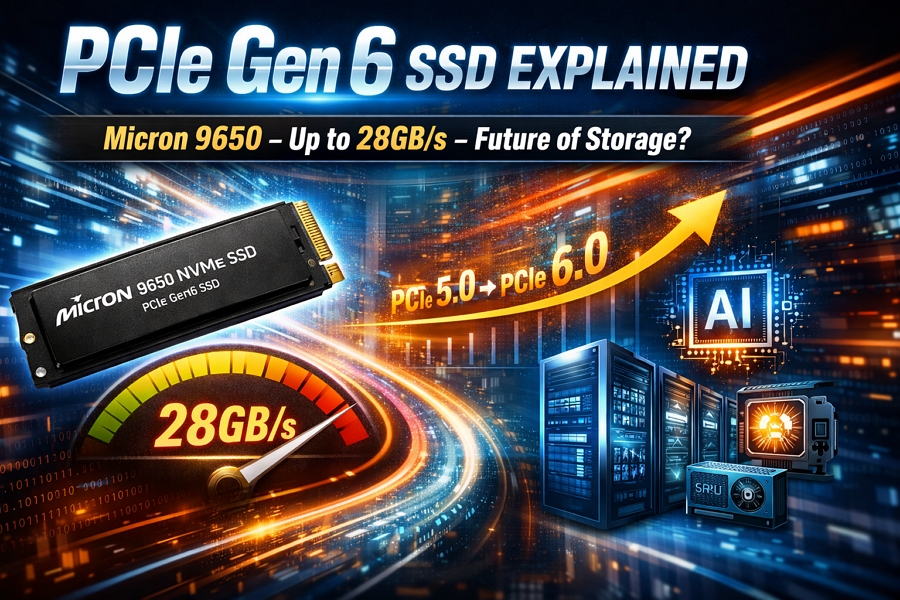
In this guide, we break down everything you need to know-from the Micron 9650 launch to real-world performance, use cases, and whether it’s worth waiting for.
The First PCIe Gen 6 SSD: Micron 9650 NVMe SSD Explained
The Micron 9650 NVMe SSD is not just another SSD release-it represents a major milestone in storage evolution, as the first PCIe Gen 6 SSD to enter production.
Compared to previous generations, the Micron 9650 is designed around extreme parallelism and sustained throughput, rather than just peak burst speed. This is critical for AI workloads, where consistent high-bandwidth access matters more than short bursts.
In enterprise environments, SSDs like the Micron 9650 are often deployed in scale-out architectures, meaning hundreds or thousands of drives operate together. In this context, even small latency improvements can significantly impact overall system performance.
The Micron 9650 NVMe SSD is the world’s first commercially available PCIe Gen 6 SSD, marking the beginning of a new storage era.
Key Specs
- Interface: PCIe 6.0 x4
- Max read speed: 28,000 MB/s
- Max write speed: ~14,000 MB/s
- Form factors: E1.S, E3.S (enterprise only)
- Capacity: Up to 30.72 TB
- Cooling: Air and liquid cooling support
What Makes It Different?
Unlike consumer SSDs, the Micron 9650 is built specifically for:
- AI training workloads
- Hyperscale data centers
- High-performance computing (HPC)
This is not a consumer SSD-it’s AI infrastructure hardware.
What Is PCIe Gen 6 SSD?
A PCIe Gen 6 NVMe SSD is a next-generation NVMe drive that uses the PCIe 6.0 interface, doubling bandwidth compared to PCIe 5.0.
While most discussions focus on raw speed, PCIe Gen 6 SSD introduces improvements in:
- Signal efficiency (via PAM4 encoding)
- Error correction mechanisms (FEC – Forward Error Correction)
- Latency consistency under load
These enhancements are especially important in environments where storage is constantly under heavy demand, such as AI training clusters.
The PCIe 6.0 standard was developed by PCI-SIG to address the exponential growth in data throughput requirements, particularly driven by:
- AI model scaling
- Real-time analytics
- High-speed networking
This means PCIe Gen 6 SSD is not an incremental upgrade—it’s a response to fundamental shifts in computing workloads.
How Fast Is PCIe Gen 6 SSD?
| Interface | Max Speed |
| SATA SSD | ~550 MB/s |
| PCIe 3.0 | ~3.5 GB/s |
| PCIe 4.0 | ~7 GB/s |
| PCIe 5.0 | ~14 GB/s |
| PCIe 6.0 | ~28 GB/s |
PCIe Gen 6 SSDs can reach:
- Up to 28GB/s read speeds
- ~14GB/s write speeds
This makes them roughly:
- 2× faster than PCIe 5.0
- 4× faster than PCIe 4.0
While 28GB/s sounds impressive, it’s important to understand how this translates into actual system performance. In high-performance environments, storage is often part of a larger pipeline that includes:
- CPU processing
- GPU acceleration
- Network throughput
If any part of this pipeline becomes a bottleneck, the benefits of faster storage may not be fully realized.
Real-World Performance
Despite the massive speed increase, real-world impact depends heavily on your workload. In real-world testing, most systems encounter limitations before reaching storage bandwidth limits:
- CPU I/O constraints
- Memory bandwidth limits
- Software inefficiencies
This is why even PCIe 4.0 SSDs are rarely saturated in consumer systems.
PCIe Gen 6 SSD shows its true value in:
- Streaming multi-terabyte datasets
- Training large language models (LLMs)
- High-frequency data ingestion systems
In these cases, storage performance directly impacts time-to-result, which is critical in enterprise environments.
Where You WILL See Gains
- AI model training
- Large dataset streaming
- Real-time analytics
Where You WON’T Notice Much Difference
- Gaming
- OS boot time
- Everyday apps
In reality, most consumer workloads don’t even saturate PCIe 4.0 SSD speeds yet.
PCIe Gen 6 vs Gen 5 SSD: What’s the Real Difference?
| Feature | PCIe 5.0 | PCIe 6.0 |
| Max Speed | ~14GB/s | ~28GB/s |
| Encoding | NRZ | PAM4 |
| Target | High-end consumer | Enterprise/AI |
Real-World Difference
- Gaming → No noticeable improvement
- Daily use → Minimal difference
- Content creation → Slight gains
- AI workloads → Major improvement
Beyond raw speed, PCIe Gen 6 introduces a shift in how data is transmitted:
- PCIe Gen 5.0 uses NRZ signaling
- PCIe 6.0 uses PAM4, doubling data density
However, PAM4 also introduces higher error rates, which is why PCIe 6.0 requires more advanced error correction and signal integrity management. PCIe Gen 6 SSD is a workload-driven upgrade, not a user-experience upgrade.
What Is PCIe Gen 6 SSD Actually Used For?
AI & Machine Learning
Modern AI systems rely on massive datasets that must be continuously streamed from storage. PCIe Gen 6 SSD reduces:
- Data loading latency
- Training pipeline stalls
- GPU idle time
This leads to higher utilization of expensive compute resources, which is a major cost factor in AI infrastructure.
Data Center Optimization
In hyperscale environments, PCIe Gen 6 SSD enables:
- Higher storage density per rack
- Faster data replication
- Improved real-time analytics
Even small efficiency gains at this scale translate into millions of dollars in savings.
Why PCIe Gen 6 SSD Feels “Overkill” for Most Users
Even though PCIe Gen 6 SSD is incredibly fast, it often feels unnecessary.
Key Reasons
- CPUs can’t fully utilize the bandwidth
- Software isn’t optimized yet
- PCIe 4.0 already exceeds most needs
Case 1. Software Lag Problem
Hardware advancements often outpace software optimization. Most applications today are not designed to take advantage of ultra-high storage bandwidth.
Examples:
- Games rely more on GPU/CPU than SSD speed
- OS operations are latency-bound, not bandwidth-bound
Case 2. Human Perception Limit
Even when improvements exist, they may fall below the threshold of human perception:
- 0.5s vs 0.3s load time → barely noticeable
- 2s vs 1.8s boot → negligible
This is why many users describe high-end SSDs as “overkill”.
Real User Perspective (VOC Insight)
Common sentiments from tech communities:
- “PCIe 4.0 is already fast enough.”
- “No difference in gaming.”
- “Feels like overkill.”
Faster storage doesn’t always translate to better real-world performance.
Can You Use PCIe Gen 6 SSD in a PC?
Short answer: No—not yet.
Why Not?
- No consumer CPU support
- No compatible motherboards
- No M.2 form factor
Current PCIe Gen 6 SSDs like the Micron 9650 NVMe SSD use enterprise interfaces (E1.S / E3.S), which are not compatible with desktops.
PCIe Gen 6 SSD Release Date
Current Timeline
- Enterprise SSDs → Available now
- Controllers → Expected around 2027–2028
- Consumer SSDs → Likely 2028–2030
Adoption Pattern
PCIe Gen 6 is expected to follow the same path as PCIe 5.0:
- Slow early adoption
- Enterprise-first rollout
- Gradual consumer availability
Challenges of PCIe Gen 6 SSD
1. Thermal Issues
Higher speeds generate more heat, often requiring advanced cooling.
2. Power Consumption
Enterprise drives consume significantly more power than consumer SSDs.
3. Cost
Early PCIe Gen 6 SSDs are extremely expensive and not consumer-friendly.
4. Signal Integrity Complexity
At higher speeds, maintaining signal quality becomes significantly harder, requiring:
- Advanced PCB design
- Shorter trace lengths
- Improved shielding
Future of PCIe Gen 6 SSD
PCIe Gen 6 SSD is not just about speed—it represents the future of data infrastructure.
Convergence with AI Infrastructure
Storage is becoming tightly integrated with compute:
- SSD → GPU direct pipelines
- Reduced CPU involvement
- Data-centric architectures
Long-Term Outlook
PCIe Gen 6 SSD will likely:
- Remain enterprise-focused in early years
- Gradually enter prosumer markets
- Eventually replace PCIe 5.0
But this transition will take time—and most users won’t need it anytime soon. Over time, the technology will trickle down into consumer SSDs—just like previous PCIe generations.
Final Words
PCIe Gen 6 SSD, led by the Micron 9650 NVMe SSD, marks a massive leap in storage performance. But here’s the reality: It’s built for AI and data centers, not everyday users. If you’re chasing cutting-edge infrastructure, it’s revolutionary. If you’re building a PC today, it’s irrelevant for now.