Affiliate Disclosure: This post may include affiliate links. If you click and make a purchase, I may earn a small commission at no extra cost to you.
In March 2026, Apple once again captured the tech world’s attention with a major refresh of its Mac lineup, significantly boosting interest in the ongoing M4 vs M5 chip debate. On March 3, Apple officially introduced the new MacBook Air equipped with the M5 chip, bringing expanded performance, larger base storage, and enhanced on-device AI capabilities to its most popular laptop. The updated MacBook Air now features double the starting storage at 512 GB, faster SSD performance, and support for Wi-Fi 7 and Bluetooth 6, alongside a 10-core CPU, up to 10-core GPU, and Neural Accelerators in every core, positioning it as a compelling upgrade for both everyday users and creators.
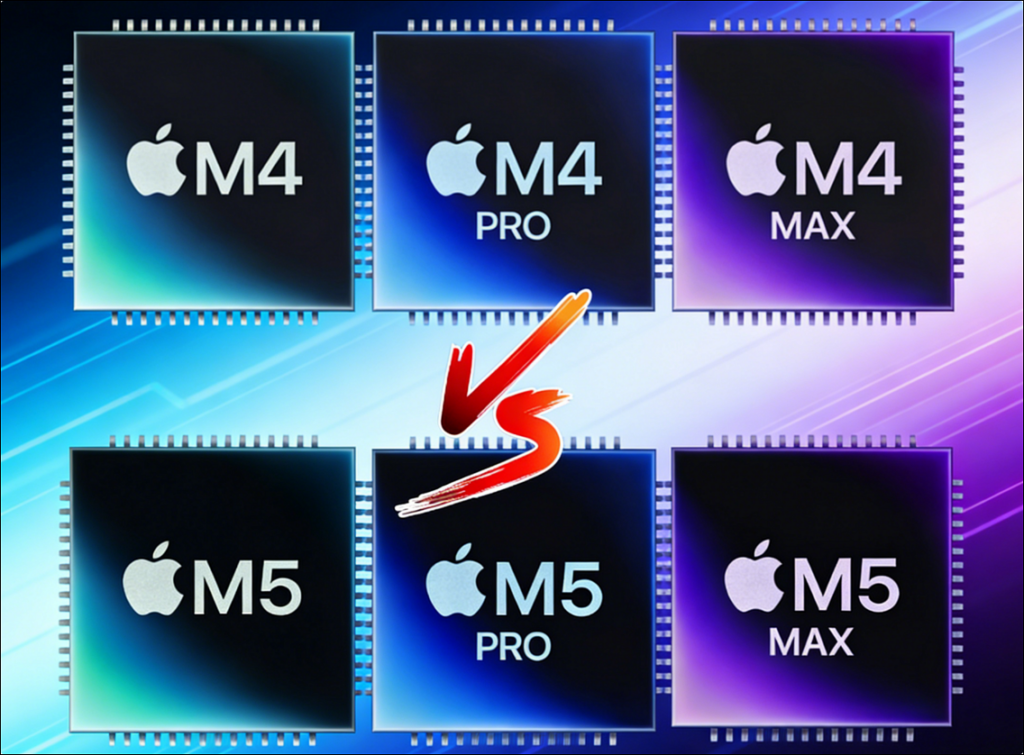
At the same event, Apple also unveiled the all-new Apple M5 Pro and Apple M5 Max powering updated MacBook Pro models, which deliver dramatically higher performance and next-level AI throughput compared with their M4 counterparts. With these simultaneous announcements, online searches and social conversations about the differences between Apple’s M4 and M5 chip families. across Base, Pro, and Max tiers. have surged, making this comparison one of the most relevant topics in Apple silicon discourse right now.
You may be interested: MacBook Air M5 vs MacBook Air M4
Apple M4 and M5 Overview
What Is Apple M4?
The Apple M4 debuted as a 3-nanometer Apple Silicon chip focused on efficiency and AI acceleration. It introduced:
- Up to 10-core CPU (performance + efficiency cores)
- Up to 10-core GPU
- Hardware-accelerated ray tracing
- 16-core Neural Engine
- Unified memory architecture
- Dynamic Caching for GPU
The M4 emphasized AI inference performance and power efficiency, making it suitable for thin devices such as the iPad Pro and later entry-level Macs.
What Is Apple M5?
The Apple M5 builds on the same advanced 3nm process but introduces deeper architectural refinement. According to Apple’s newsroom releases, M5 prioritizes:
- Higher CPU and GPU performance scaling
- Significantly improved AI compute
- Greater memory bandwidth
- Expanded GPU core counts in Pro/Max models
- Enhanced efficiency per watt
The M5 family powers updated versions of the MacBook Pro and other high-performance Apple devices, with Pro and Max tiers aimed at demanding creative and AI workflows.
M4 vs M5 Chip: Architectural Differences
CPU Architecture
Both the Apple M4 and Apple M5 use a hybrid CPU design that combines performance cores and efficiency cores. At the base level, core counts remain similar (up to 10 cores), so the generational difference is not about adding more cores.
Instead, M5 focuses on architectural refinements. It features improved instruction scheduling, better cache optimization, and higher sustained clock speeds under heavy workloads. These changes increase overall throughput and help maintain stable performance during long tasks.
The advantage becomes clearer in the Pro and Max tiers, where M5 delivers stronger multithreaded scaling. For workloads like video encoding, 3D rendering, or large code builds, M5 maintains performance more consistently over time.
In short, while M4 is already powerful, M5 is better optimized for sustained professional and parallel workloads.
Unified Memory & Bandwidth
Apple Silicon’s unified memory architecture remains central to both generations.
| M4 | M5 | |
| Memory Type | Unified | Unified |
| Max Base Memory | 24GB | 32GB (varies by model) |
| Memory Bandwidth (Base) | ~120 GB/s | Up to ~150+ GB/s |
| Pro/Max Bandwidth | High | Significantly Higher |
In Pro and Max variants, memory bandwidth scaling is more dramatic. M5 Pro and M5 Max introduce higher ceilings that directly benefit:
- 8K video editing
- Large AI model inference
- Complex 3D scene rendering
- Multi-stream ProRes workflows
Bandwidth gains are especially impactful for GPU-heavy tasks.
GPU & Graphics Enhancements
| M4 | M5 | |
| Base GPU Cores | Up to 10 | Up to 10 (refined) |
| Pro GPU Cores | Up to ~20 | Higher scaling |
| Max GPU Cores | ~30 range | Up to ~40 |
| Ray Tracing | Yes | Improved throughput |
| AI Graphics Acceleration | Yes | Enhanced |
M5 Pro vs M4 Pro
The gap between M4 and M5 becomes more noticeable in the professional tier. While the Apple M4 Pro already delivers strong performance for creators and developers, the Apple M5 Pro focuses on better scaling, higher sustained throughput, and improved efficiency under demanding workloads.
CPU Performance
M5 Pro enhances multithreaded scaling and maintains higher sustained performance during prolonged heavy tasks. It is also more thermally efficient, allowing consistent output under load. This benefits workflows such as large code compilations, running multiple virtual machines, complex multi-layer Photoshop projects, and extensive Xcode builds.
GPU & AI Compute
On the graphics and AI side, M5 Pro introduces stronger GPU scaling and higher AI throughput. Users can expect smoother 3D rendering previews, more responsive real-time effects in Final Cut Pro, improved AI-powered upscaling and denoising, and faster on-device machine learning inference.
Memory Scaling
M5 Pro also supports higher memory ceilings and increased bandwidth. This reduces bottlenecks in multi-cam 4K/8K editing, large dataset processing, and machine learning development, making it a more future-ready option for professional workloads.
M5 Max vs M4 Max: Extreme Performance Tier
| M4 Max | M5 Max | |
| CPU Cores | High | Higher efficiency & scaling |
| GPU Cores | ~30 | Up to ~40 |
| Memory Ceiling | High | Higher |
| Bandwidth | Very High | Significantly Higher |
| AI Throughput | Strong | Much Stronger |
Real-World Gains
- 3D Rendering: M5 Max shortens render cycles in Blender and similar tools.
- AI Workloads: Faster LLM inference and higher throughput for generative workflows.
- Video Production: More real-time layers, smoother color grading.
Side-by-Side Summary Table
| M4 | M5 | |
| Process | 3nm | Enhanced 3nm |
| CPU Design | Hybrid | Refined Hybrid |
| GPU Ray Tracing | Yes | Improved |
| Neural Engine | 16-core | Enhanced throughput |
| Max GPU Cores (Max) | ~30 | ~40 |
| Memory Bandwidth | High | Higher |
| AI Performance | Strong | Significantly Stronger |
| Best For | General + Creative | AI + Pro Workflows |
M4 vs M5: Which Chip Should You Choose?
Choose M4 If:
- You perform general productivity tasks
- You edit occasional 4K videos
- Budget is a key factor
- You don’t rely on AI-heavy workflows
Choose M5 Base If:
- You want stronger AI performance
- You multitask heavily
- You want longer-term futureproofing
Choose M5 Pro If:
- You edit video professionally
- You compile code frequently
- You work with large design assets
Choose M5 Max If:
- You render 3D scenes daily
- You train or run AI models locally
- You need maximum GPU throughput
Final Verdict: M4 vs M5 Chip
The difference between M4 vs M5 chip is evolutionary at the Base level but increasingly significant in Pro and Max tiers.
- M4 delivers excellent efficiency and strong performance.
- M5 refines architecture, expands GPU scaling, boosts AI throughput, and increases memory bandwidth, especially for professionals.
If your workflows are graphics-intensive or AI-accelerated, M5 (particularly Pro/Max) offers tangible advantages. If your needs are moderate, M4 remains a powerful and cost-effective option.