Affiliate Disclosure: This post may include affiliate links. If you click and make a purchase, I may earn a small commission at no extra cost to you.
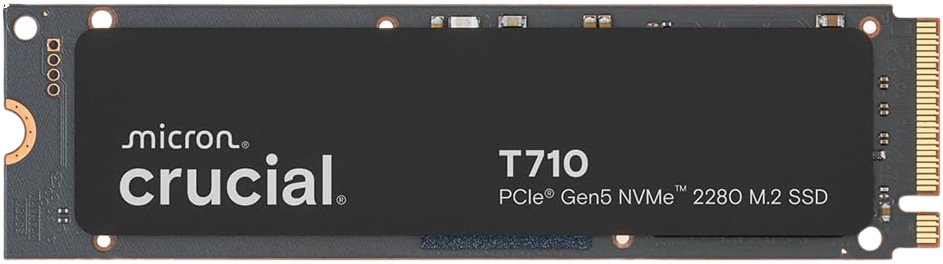
WD Black SN8100 and Crucial T710 are two very popular Gen 5.0 SSDs. The SN8100 is by far the fastest Gen 5.0 drive in the market, while the T710 is right behind in the charts. So, in terms of performance, both of these are going to give you great results. But which one is more suitable for your specific needs? Which one will provide you with a better value for money? We will discuss this topic in this article.
Both drives utilize TLC NAND flash, and each has its own DRAM. The Crucial T710 uses the Micron B68S FortisFlash TLC (276-layer), which is the fourth-generation charge-trap flash. It comes with enhanced durability and is suitable for high-endurance applications.
The WD Black SN8100, on the other hand, is equipped with Kioxia’s BiCS8 TLC (218-layer), which is the eighth-generation BiCS Flash. It supports up to 3.2 GT/s with much higher bit density. All in all, the T710’s NAND flash is suitable for demanding tasks and sustained performance. However, the SN8100’s NAND, having fewer layers, offers superior power efficiency. Its advanced wafer bonding enables it to achieve the performance it’s delivering.
The controller is the same in both drives, i.e., Silicon Motion SM2508. It has the ARM Cortex-R8 Quad-core processor with eight channels. It supports up to 3600 MT/s per channel. It is based on the 6nm process, which makes it efficient and thermally stable.

So, the technical specifications are almost identical across both SSDs, which is why they are leading the Gen 5.0 category with their excellent performance. But there will be differences in performance, specifications, and prices. We are going to cover everything in this article so that you can make a fine decision. So, without any delays, let’s get started.
Crucial T710 vs WD Black SN8100 Specifications
| Specification | Crucial T710 | WD Black SN8100 |
|---|---|---|
| PCIe Generation/NVMe Version | PCIe Gen 5.0 x4/ NVMe 2.0 | PCIe Gen 5.0 x4/ NVMe 2.0 |
| Release Date | May 19th, 2025 | May 2025 |
| Capacities | 1TB, 2TB, 4TB | 1TB, 2TB, 4TB |
| Sequential Read Speed | 1TB: 14,900 MB/s 2TB: 14,500 MB/s 4TB: 14,500 MB/s | 1TB: 14,900 MB/s 2TB: 14,900 MB/s 4TB: 14,900 MB/s |
| Sequential Write Speed | 1TB: 13,700 MB/s 2TB: 13,800 MB/s 4TB: 13,800 MB/s | 1TB: 11,000 MB/s 2TB: 14,000 MB/s 4TB: 14,000 MB/s |
| Random Read Speed | 1TB: 1,800K IOPS 2TB: 2,200K IOPS 4TB: 2,200K IOPS | 1TB: 1,600K IOPS 2TB: 2,300K IOPS 4TB: 2,300K IOPS |
| Random Write Speed | 1TB: 2,200K IOPS 2TB: 2,300K IOPS 4TB: 2,300K IOPS | 1TB: 2,400K IOPS 2TB: 2,400K IOPS 4TB: 2,400K IOPS |
| NAND Flash | Micron B68S FortisFlash TLC (276-layer) | Kioxia’s BiCS8 TLC (218-layer) |
| DRAM | Yes | Yess |
| Controller | Silicon Motion SM2508 | Silicon Motion SM2508 |
| Price | Starting from $149.99 for 1TB | Starting from $154.99 for 1TB |
The Crucial T710WD leverages Micron’s newer 276-layer B68S FortisFlash TLC, which generally delivers higher sequential write speeds at lower capacities (up to 13,800 MB/s versus 11,000 MB/s on the SN8100 1TB model) and slightly better random read performance at 1TB.
Conversely, the Black SN8100 relies on Kioxia’s 218-layer BiCS8 TLC, which, while slightly older in layer count, maintains stronger consistency at higher capacities, with sequential write speeds matching or exceeding the T710WD at 2TB and 4TB. Random write performance is also marginally higher across all capacities for the SN8100.
Overall, the T710WD appears optimized for peak performance at lower capacities, likely benefiting from Micron’s denser NAND. In contrast, the SN8100 shows steadier scaling at larger capacities, emphasizing throughput consistency and high IOPS endurance.
Benchmark Scores Comparison
All the benchmark scores are for the 2TB variants of both drives.
PCMark10 Full Drive Benchmark

Looking at these PCMark 10 results, the WD Black SN8100 clearly outperforms the Crucial T710 in both speed and responsiveness. Its overall score of 7694 versus 6583 for the T710 reflects a roughly 17% advantage in real-world workloads like app launches, file transfers, and OS boot times. Bandwidth is also notably higher at 1185 MB/s compared to 1033 MB/s, meaning sustained transfers will complete faster, while the lower latency of 21 µs versus 25 µs ensures snappier random access performance. In practical terms, the SN8100 will feel significantly more responsive in daily use, loading large files and multitasking more smoothly. In contrast, the T710, though competent, feels like a step behind in both speed and instant responsiveness.
3DMark Storage Test for Gamers

Looking at the 3DMark Storage Benchmark, the pattern is consistent with the PCMark 10 results but even more pronounced. The WD Black SN8100 posts a score of 8,100 versus the Crucial T710’s 6,647 — a ~22% lead — showing that under gaming- and graphics-oriented storage workloads, the WD handles data much more efficiently. Bandwidth differences are also stark: 1,377 MB/s for the SN8100 versus 1,138 MB/s for the T710, which translates to faster asset streaming and shorter load times in games. Latency favors the WD as well, at 22 µs compared to the T710’s 27 µs, meaning smaller files and random reads are completed more quickly, reducing stutters and improving overall system responsiveness. In short, the SN8100 will perform better in gaming and 3D-related tasks.
CrystalDiskMark Peak Sequential Read/Write Performance

Now, this is interesting — when we switch to sequential synthetic benchmarks, the differences basically vanish. Looking at the 1M sequential read/write tests at QD1 and QD8, both drives are almost neck-and-neck:
- Read speeds: T710 slightly edges the SN8100 in QD1 read (9,737 vs 9,609 MB/s), but QD8 reads are essentially identical (14,293 vs 14,307 MB/s).
- Write speeds: Similar story — the SN8100 pulls ahead a little in QD8 writes (13,740 vs 13,544 MB/s), while T710 is marginally faster in QD1 writes (10,796 vs 10,381 MB/s).
In short, for large, continuous file transfers, both drives perform remarkably similarly. The WD Black’s real advantage shows up in latency-sensitive, random-access workloads.
CrystalDiskMark Peak Random Read/Write Performance

When you look at these numbers side by side, the WD Black SN8100 edges out the Crucial T710, where it actually matters for most users — light-load responsiveness and write performance. Its 4KB QD1 read score is about 17% higher, meaning faster boot times, snappier app launches, and better everyday responsiveness. Write performance at QD1 is effectively identical, but at heavy queue depths, the WD also pushes stronger sustained write IOPS, showing better efficiency under parallel load. The Crucial T710 fights back with a slight lead in deep-queue reads, making it more appealing for read-heavy, professional, or enterprise-style workloads; however, this edge won’t be noticeable in consumer use. Bottom line: the SN8100 feels faster and more consistent for gaming or general desktop tasks, while the T710 is the better pick for heavy-duty, read-intensive environments.
Transfer Rate Benchmark

Between the Crucial T710 (2TB) and WD Black SN8100 (2TB), the differences are small but telling. The WD Black SN8100 leads in low-queue-depth reads (32,847 vs. 28,071 IOPS), which translates to snappier system responsiveness in everyday use. Both drives are dead even in QD1 writes, but the tables turn under heavier loads: the Crucial T710 pulls slightly ahead in deep-queue reads (1.97M vs. 1.88M IOPS), showing better scaling for parallel read-heavy workloads, while the WD Black wins on deep-queue writes (1.90M vs. 1.74M IOPS). Overall, the WD Black SN8100 feels faster for typical consumer or gaming use, while the Crucial T710 flexes more muscle in heavy, read-intensive, or workstation scenarios.
Power Consumption and Efficiency

The Crucial T710 has a higher MB/s per watt (790 vs 686 MB/s) compared to the WD Black SN8100. The T710 has a lower average power consumption by 1 watt. The WD Black SN8100 has lower idle power consumption—about 200 milliwatts — than the T710. The maximum power consumption under load is lower with the WD Black SN8100. So, we can conclude that the SN8100 will consume more power overall. However, when we put these drives under load, the T710 will consume more power. These results were mixed, but on a per-watt basis, the T710 is much more efficient.
TBW, MTBF, DWPD, and Warranty Period
| Feature | Crucial T710 | WD Black SN8100 |
|---|---|---|
| Endurance (TBW) | 1TB: 600 TBW 2TB: 1200 TBW 4TB: 2400 TBW | 1TB: 600 TBW 2TB: 1200 TBW 4TB: 2400 TBW |
| Warranty | 5 Years | 5 Years |
| DWPD | 0.3 | 0.3 |
| MTBF | 1.5 Million Hours | 1.8 Million Hours |
The TBW, MTBW, and Warranty periods are identical in both drives. However, there is a difference in the MTBF (Mean Time Between Failure), and SN8100 is leading here. So, there is a bit more reliability here when you pick the SN8100. But, this will not make any substantial difference in terms of endurance.
Technical Specifications
| Specification | Crucial T710 | |
|---|---|---|
| Controller | Silicon Motion SM2508 | Silicon Motion SM2508 |
| Controller Architecture | ARM 32-bit Cortex-R8 + ARM 32-bit Cortex-M0 (5-Core) | ARM 32-bit Cortex-R8 + ARM 32-bit Cortex-M0 (5-Core) |
| DRAM Specifications | Micron’s LPDDR4-4266 1TB: 1×1024 MB 2TB: 1×2048 MB 4TB: 1x 4096 MB | DDR4 DRAM 1TB: 1×1024 MB 2TB: 1×2048 MB 4TB: 1x 4096 MB |
| SLC Write Cache | 1TB: – 2TB: approx. 368 GB (dynamic only) 4TB: – | 1TB: – 2TB: approx. 600 GB 4TB: – |
| NAND Flash | Micron’s B68S FortisFlash | Kioxia’s BiCS8 |
| Topology | 276-Layers | 218-layer |
| NAND speed | 3600 MT/s | 3600 MT/s |
| Read Time (tR)/Program Time (tProg) | 32 µs/320 µs | 40 µs/- |
| Die Write Speed | 300 MB/s | 205 MB/s |
| Encryption | AES-256, TCG Opal | TCG Opal |
| Power Loss Protection | No | No |
| SMART/TRIM/PS5 Support | Yes/Yes/Yes | Yes/Yes/Yes |
| Heatsink Option | Yes | Yes |
| More Information | Datasheet | Datasheet |
The Crucial T710 pairs that controller with Micron’s new B68S FortisFlash, a 276-layer NAND running at 3600 MT/s, while the other drive uses Kioxia’s older 218-layer BiCS8 NAND at the same interface speed. That gives the T710 an edge in both read and program efficiency.
T710’s tR/tProg times (32 µs / 320 µs) are noticeably quicker, and its die write speed hits 300 MB/s versus 205 MB/s, a roughly 46% advantage. Both drives support AES-256 and TCG Opal encryption. Overall, the Crucial T710 delivers a more advanced NAND structure and faster per-die throughput, making it the better performer in heavy workloads. At the same time, the BiCS8-based model likely trades a bit of speed for cost efficiency and thermal stability.
Price
In most cases and marketplaces, the T710 is a little expensive than the SN8100. By the time I write this article, the 1TB Crucial T710 is selling for $154.99, while the SN8100 is available for $149.99. All other variants are at a similar difference. But the prices keep changing, and I recommend checking them before you make your final decision.

Final Verdict: Which one should you choose?
If you are getting the SN8100 at a lower price than the T710, as I am getting right now, it is definitely the best choice for you. In fact, I would recommend paying a little more for the SN8100 if you want to experience the best Gen 5.0 performance on your system. For applications such as content creation (4K-12K editing), VFX, high-performance computing, competitive gaming, and machine learning, where high throughput is advantageous, the SN8100 is a worthwhile investment.
On the same note, most people would hardly notice any difference in performance as long as you are doing tasks that push the ultimate limits of Gen 5.0 storage. So, the Crucial T710 will feel almost the same as the SN8100. So, if you can save some money on your purchase, the T710 isn’t a bad decision at all. It may also run cooler than the SN8100 under loads.
So, the final decision will depend on how much you can save on your purchase. Also, keep in mind that if you are planning to use these drives under heavy workloads, they can get pretty hot. So, using a heatsink would be advised. Fortunately, both drives have the heatsink variants.
I hope this helps.