Affiliate Disclosure: This post may include affiliate links. If you click and make a purchase, I may earn a small commission at no extra cost to you.
TBW and DWPD are two crucial factors that determine your SSD’s lifespan and endurance. MTBF is another generalized specification that determines how many hours an SSD will operate on your computer.
All these things decide the endurance of your SSD. Therefore, it is essential to discuss these aspects and verify them before purchasing an SSD.
SSD endurance is never an easy thing to calculate in case of non-wear-out failures, which are generally caused by excess heat, electrical faults, firmware issues, and other problems in the drive. These faults will come before the TBW or warranty periods have been reached.
SSD endurance ratings are primarily concerned with wear-out issues. TBW, for example, indicates the total amount of data your SSD can write before its endurance rating is surpassed. Let’s talk in detail about three of the most essential endurance factors in SSDs, i.e., TBW, DWPD, and MTBF.

What is TBW in SSDs?
TBW, or Terabytes Written, is a measure of the total data that can be written to an SSD before its lifetime ends. This parameter is considered to determine the endurance and reliability of any SSD. Manufacturers provide these numbers in TB, and they can vary depending on several factors.
The actual lifespan of an SSD depends on the type of workload it is subjected to. If you do high write operations or use write-intensive applications, your drive will reach TBW limits faster.
Even to determine the warranty period of any SSD, manufacturers use the TBW as a benchmark. Drives with higher TBW will generally come with a higher warranty period as well.
How is TBW determined?
The first and most important thing determining the TBW in SSDs is the type of NAND flash cells. SLCs have the highest TBW, while QLCs have the lowest. Larger drives generally offer higher TBW compared to drives with lower capacities.
Write Amplification Factor is another major contributor. This number highlights the amount of extra data the SSD will write for any given data amount. Why SSDs have to write additional data is explained here. A WAF of 1.5 indicates that for writing 1 TB of actual data, the drive will have to write 1.5 TB of data. This additional data is due to the internal tasks of the SSDs, including wear leveling and garbage collection.
Many other factors determine the SSD TBW, including controller efficiency, over-provisioning, ECC mechanism, and wear-leveling techniques.
So, all in all, the manufacturers put these drives into testing and give specific numbers as their drive’s TBW. The Write Amplification Factor and Over-Provisioning are determined and designed by the manufacturers, taking into account the components used in the SSD. However, please note that these are not definitive numbers. Your SSD can fail prematurely due to a condition known as non-wear-out failure.
How is TBW calculated?
We do not need to perform any calculations in the case of TBW because manufacturers provide the numbers themselves. You can check it on the product page or the SSD datasheet. However, the formula used by the manufacturers is this:
TBW = (NAND Endurance) × (Total Capacity) × (WAF) × (Over-Provisioning Factor)
NAND Endurance is the number of total P/E cycles. This number is derived from the type of NAND flash used in that SSD. SLC has the highest P/E ratio while QLC has the lowest.
The overprovision factor determines how much extra space is allocated for the internal working of SSDs that cannot be used for primary storage. For a 1TB (1000GB) SSD, a 10% overprovisioning factor means 100GB is over-provisioned space, and 900GB is user-accessible capacity.

The total P/E cycles of the NAND flash are one of the key factors, as we saw in our formula. Unfortunately, manufacturers don’t disclose the WAF and OPF of their drives. So, we can’t calculate it on our own.
According to our calculation for a TLC SSD with a 1TB drive, the TBW came out to be 1650TB, which is a very high and rare number to see. Therefore, either there are compromises with the P/E cycles in the NAND flash or with WAF or OPF.
What is DWPD in SSDs?
DWPD stands for Drive Writes Per Day. This metric is used to understand how many times the total capacity of an SSD can be written to or overwritten every day during the warranty period without exceeding the drive’s endurance limits. DWPD is a user-centric metric that helps us understand how much data we can write on our drive daily for how long.
DWPD is determined by considering TBW and the warranty period for any SSD. So, you can say that DWPD and TBW are directly proportional if the warranty and capacity of SSDs are the same. If the TBW is high, the DWPD will also be higher.
The DWPD number indicates the number of times you can write the entire SSD size to it. If the DWPD is one for a 1TB drive with a 5-year warranty, you can write 1TB of data to your drive every day for 5 years. After five years of this much data, the drive will reach its endurance limits.
How is DWPD calculated?
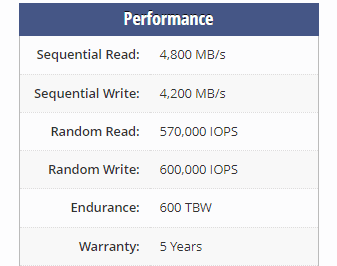
There is a simple formula to calculate the DWPD from your SSD’s storage capacity, TBW, and warranty period. If you have these three, you can easily extract the DWPD from them. Here is the formula and an example DWPD calculation for Crucial T700.

For an SSD with a 1TB capacity, 600TBW, and a 5-year warranty, we obtain 0.329 DWPD. This means we can write approximately 32.9% or 329 GB on a Crucial T700 every day for five years. If you write this amount of data every day, after five years, the SSD endurance limit will be exceeded, and it may no longer remain usable.
What is MTBF in SSDs?
MTBF is a reliability metric that estimates the total time (in hours) before the failure of an SSD. This metric is also used in various other electronic items and components. However, for SSDs, this indicates the reliability of the SSD. So, a higher MTBF indicates better reliability.
The manufacturer recalculates the MTBF using accelerated testing, user data, and historical failure rates.
Also, MTBF is the opposite of the failure rate in SSDs. If one out of 10,000 SSDs fails during the testing period, the MTBF will be 10,000 hours.
How is MTBF calculated?
Manufacturers conduct tests on multiple drives for a significant period. Then, the total number of failed drives is checked. When the total operational time of all drives and the total number of failed drives are calculated, they result in several hours. The formula and calculation are like this:
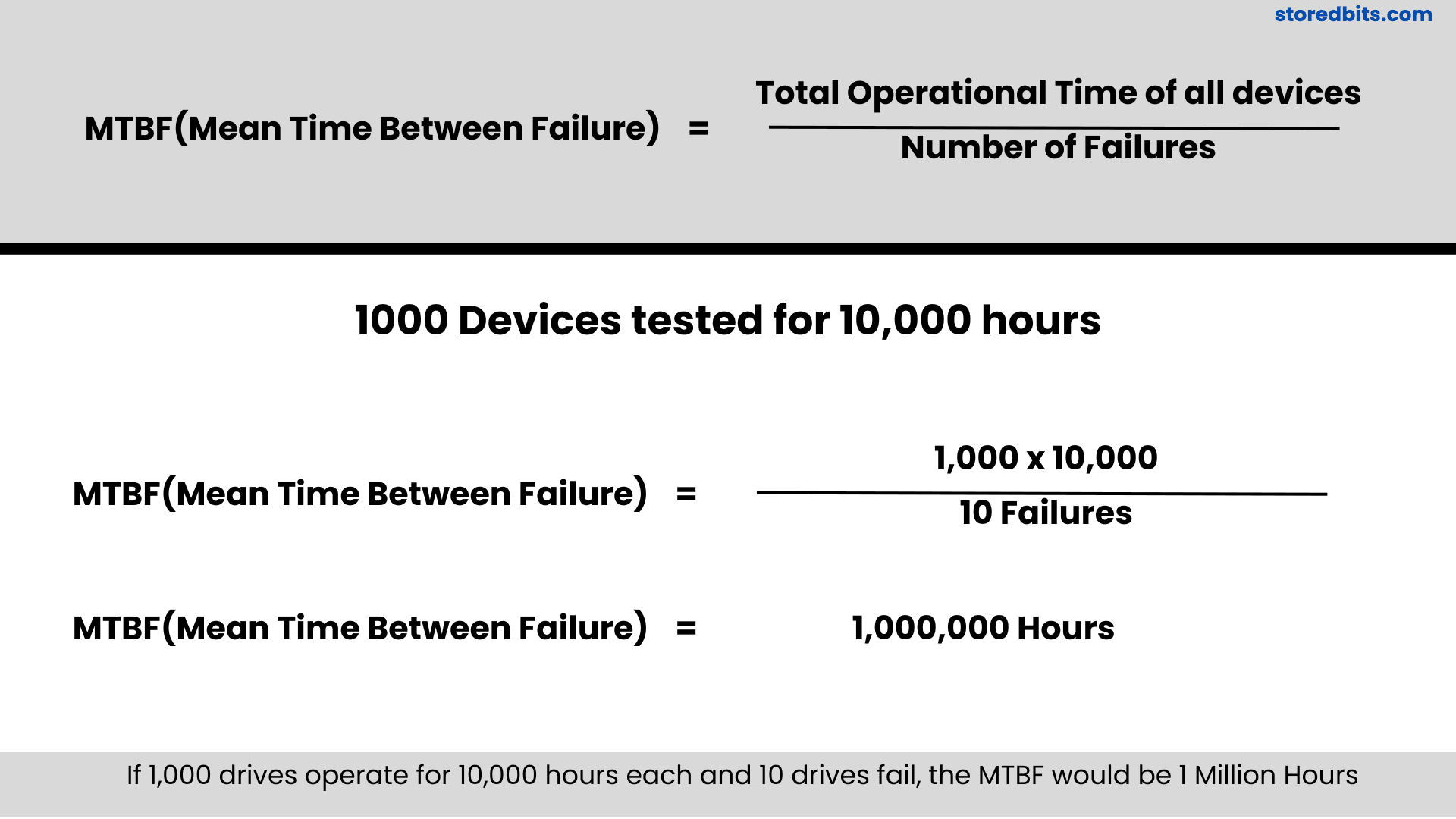
In our example, 1000 drives were tested for 10000 hours. Ten drives failed during the test. From the calculation, we reached 1 million hours. MTBF is a good estimation metric for the bulk of the drive, but it doesn’t provide much insight into the individual drive, depending on its specific specifications.
What happens when an SSD reaches its TBW limit?
Although it is challenging to surpass the TBW limits within the warranty period in the consumer environment, you will eventually surpass them if the drive continues to function for years. After the TBW limit is reached, the first thing your drive will do is enter read-only mode—the chances of data loss increase at any time. The performance degrades, and the drive is prone to failure at times. In simple words, it can not be used to store any critical data reliably even if it looks fine.
Which one is the End-of-life indicator of an SSD?
TBW is partially an End-of-life indicator because reaching TBW directly means the SSD can fail at any time. Neither DWPD nor MTBF is an End-of-life indicator in any way. TBW also doesn’t directly state that the SSD will die because the drive may continue to function without issues even after reaching its TBW limits.
DWPD is a simple calculation that helps users who perform more intense write operations daily. Individuals who work with large video files and frequently move files can use DWPD as a measure to ensure the good usability of their drives.
MTBF is an estimate provided by manufacturers through bulk testing of thousands of drives. Although these numbers are derived from multiple drives, a good MTBF indicates that your drive was manufactured with proper care for endurance.
How is the warranty period determined in SSDs?
Most of the modern SSDs including NVMe and SATA (enterprise and consumer) come with the standard 5-year warranty. These are mostly the TLC SSDs. Most QLC SSDs come with a 3-year warranty. This is because the warranty is also majorly dependent on the P/E cycles of the NAND flash just like the TBW.
The warranty period can have implications for brand reputation, so manufacturers try to provide the best possible warranty terms. Five years is an ideal warranty period in the SSD market. However, failures can occur at any time because SSDs are electronic components that rely on electricity.

![How to Buy and Upgrade Laptop RAM? [Detailed Guide]](https://storedbits.com/wp-content/uploads/2024/10/push-the-ram-stick.jpg)