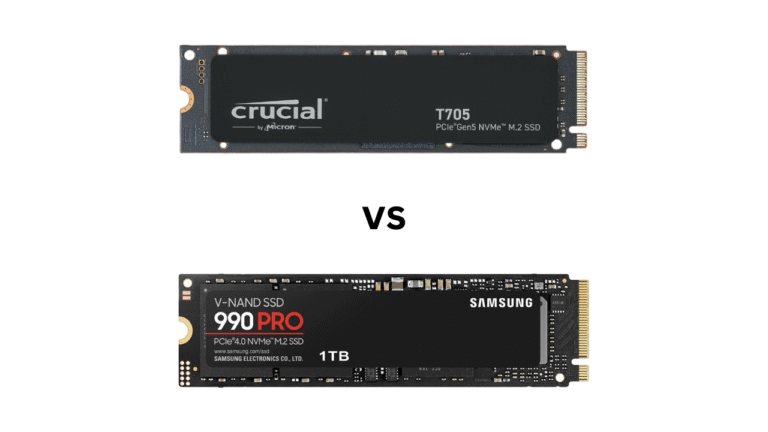
The Crucial T705 and Samsung 9100 Pro are two very popular high-end Gen 5.0 drives. Both drives have almost the same prices and even the specifications. Below, when we compare the benchmarks, you’ll see that both have pretty similar performance as well. So, it is easy to get confused here. But, I am going to clear all your confusions in this comparison.
Both drives have the TLC NAND flash. The 9100 Pro comes with a 236-layer V8 V-NAND from Samsung, while the T705 has 232-layer Micron’s B58R FortisFlash. Both are almost similar in performance and efficiency. They are used in the flagship products of both brands. So, there is hardly anything to compare here. But the Samsung V-NAND (V8) is known for its consistent performance thanks to better firmware tuning. But, the B58R FortishFlash can offer you a comparatively better thermal performance in some cases.
Samsung’s Presto controller is based on a 5nm process and has 8 flash channels. The Phison E26 controller in the SN770 also has 8 flash channels, but it is based on a much older 12nm process. So, the 9100 Pro’s controller is surely much more efficient in terms of thermal performance and power consumption.
Both SSDs have their own DRAM, a good enough SLC write cache, encryption, and similar TBW ratings. So, specification-wise, they are pretty competitive but we will still find some differences in this article and help you reach a good decision.

Theoretically, the Samsung 9100 Pro looks and sounds better, but we’ll look at the benchmarks before reaching a conclusion. So, let’s start our comparison.
Theoretical Specifications
Let’s first compare the theoretical specifications of both to have a basic overview of both the drives and what the brands are promising.
| Specification | Samsung 9100 Pro | Crucial T705 |
|---|---|---|
| PCIe Generation/NVMe Version | PCIe Gen 5.0 x4/ NVMe 2.0 | PCIe Gen 5.0 x4/ NVMe 2.0 |
| Release Date | Feb 27th, 2024 | Feb 20th, 2024 |
| Capacities | 1TB, 2TB, 4TB, 8TB | 1TB, 2TB, 4TB |
| Sequential Read Speed | 1TB: 14,700 MB/s 2TB: 14,700 MB/s 4TB: 14,800 MB/s 8TB: 14,800 MB/s | 1TB: 13,600 MB/s 2TB: 14,500 MB/s 4TB: 14,100 MB/s |
| Sequential Write Speed | 1TB: 13,300 MB/s 2TB: 13,400 MB/s 4TB: 13,400 MB/s 8TB: 13,400 MB/s | 1TB: 10,200 MB/s 2TB: 12,700 MB/s 4TB: 12,600 MB/s |
| Random Read Speed | 1TB: 1,850K IOPS 2TB: 1,850K IOPS 4TB: 2,200K IOPS 8TB: 2,200K IOPS | 1TB: 1,400K IOPS 2TB: 1,550K IOPS 4TB: 1,500K IOPS |
| Random Write Speed | 1TB: 2,600K IOPS 2TB: 2,600K IOPS 4TB: 2,600K IOPS 8TB: 2,600K IOPS | 1TB: 1,750K IOPS 2TB: 1,550K IOPS 4TB: 1,500K IOPS |
| NAND Flash | Samsung’s V8 V-NAND TLC (236-layer) | Micron’s B58R FortisFlash TLC (232-layer) |
| DRAM | Yes | Yes |
| Price | 1TB starting at 135.66$ | 1TB starting at 129.99$ |
The Samsung 9100 Pro is built around Samsung’s in-house controller and 236-layer TLC NAND, with a PCIe 5.0 ×4/NVMe 2.0 interface. It delivers up to 14,800 MB/s sequential read and 13,400 MB/s sequential write, with random I/O peaks up to 2.2 million IOPS (reads) and 2.6 million IOPS (writes) on the higher-capacity SKUs. Meanwhile, the Crucial T705 uses a Phison PS5026-E26 controller paired with Micron’s B58R 232-layer TLC NAND, likewise supporting PCIe 5.0 ×4 / NVMe 2.0 . Its stated specs reach up to 14,500 MB/s for sequential reads and ~12,700 MB/s for sequential writes, with random reads at 1.55 million IOPS and writes at 1.8 million IOPS in the 2TB/4TB variants.
In essence, while both drives exploit Gen 5.0 bandwidth and modern high-density NAND, the 9100 Pro edges ahead in raw specifications, showing higher sequential throughput and higher random IOPS. The T705 offers powerful performance as well, but trails slightly in maximum throughput/IOPS, and its actual performance will depend more on implementation (heatsink, cooling, firmware). For systems that can fully exploit PCIe 5.0 ×4 and where heavy workloads (large file transfers, high QD random I/O) matter, the 9100 Pro is the technically superior choice.
Benchmark Scores Comparison
The benchmark scores are of the 2TB variants of both drives and double-checked for accuracy.
PCMark 10 Full Storage benchmark
PCMark 10 Full Storage Benchmark runs different tests on your SSDs, simulating the real-world environments that an OS drive has to go through. A better PCMark 10 score, higher bandwidth, and lower latency mean your drive will work well as your primary drive.

The Samsung 9100 Pro scored 6597 in PCMark 10, while the Crucial T705 scored 6541. So, the Samsung 9100 Pro has a 0.85% higher PCMark 10 score compared to the Crucial T705. Looking at bandwidth, the 9100 Pro offers around 30.42% more bandwidth of 1037 MB/s than the T705’s 763 MB/s. Latency is the same in both, i.e., 25 microseconds. All, in all, in the real-world applications like content creations, you can expect similar performance but if you go into the nitty-gritty, the 9100 Pro will have a slight advantages here.
3DMark Storage Benchmark for Gamers
3DMark Storage benchmark for gamers tests a drive’s capabilities in different gaming-related scenarios. The tasks mainly include installing, loading, saving, closing, and streaming games. A higher 3DMark score will always mean an SSD is better for gaming compared to the lower scores. Again, you get bandwidth and latency in MB/s and microseconds. Let’s see what these drives have on offer.

If we look at the 3DMark scores, the Crucial T705 has a 5.76% higher score of 6739 compared to the 9100 Pro’s 6371. The Crucial T705 also has 42 MB/s more bandwidth. The latency is 2 microseconds lower with the T705 at 26 compared to the Samsung 9100 Pro’s 28 microseconds. Again, the differences are not huge, but if we have to conclude, the T705 is going to give you a little better gaming performance. But, that doesn’t mean the 9100 Pro is a bad SSD for gaming. You can expect similar results from it as well.
CrystalDiskMark Peak Sequential Read/Write Speed

The peak sequential numbers are not that different between these drives. The big difference is seen in the sequential 1MB QD8 write speed, which is about 522 MB/s higher on the Crucial T705. In the 1M test at a queue depth of 8, the 9100 Pro has around 120 MB/s higher speed. So, the results are mixed, but in 3 tests out of 4, the 9100 Pro wins, and we can declare our winner in that way.
CrystalDiskMark Peak Random IOPS

In the random read/write IOPS, bigger peak performance differences can be seen. Firstly, in the 4KB test at a queue depth of 256, the 9100 Pro delivers around 340K IOPS higher than the T705. At the same QD, in the write test, the 9100 Pro gave us 163K higher IOPS. The difference at the Queue Depth of 1 is lower. But, if we have to declare the winner in this test, it’s again the 9100 Pro.
File Read and Write Speed Comparison

In the raw file copy, read, and write tests, the Crucial T705 performs surprisingly better than the 9100 Pro.
Power Consumption and Efficiency

The MB/s per watt is slightly better in the Crucial T705 by around 15MB/s. So, we can say that it is more efficient/. However, the average and idle power consumption are higher in the T705, which can contribute negatively to heat generation and may require some kind of thermal solutions. The maximum power consumption under load also goes to 11 watts in the T705 compared to the 9100 Pro’s 8 watts.
Write speed after SLC exhaustion.
The sustained write speeds are way better in the T705 compared to the 9100 Pro. To give you a little context, the raw speed of the NAND flash in the T705 is slower than that of the 9100 Pro. But, the average write speed after 15 minutes at 1 MiB blocks and a queue depth of 32 is 4029 MB/s compared to 9100 Pro’s 1867 MB/s. However, the cache lasts longer in the Samsung 9100 Pro for almost double the duration of T705. However, what contributes to T705’s higher sustained average write speed is its higher raw write speed compared to the 9100 Pro. So, if your workload includes writing big chunks of data, which happens with content creators, the T705 can offer you better results.
Thermals
The E26 controller is known for its higher heat generation, and it is clear that when we compare it with Samsung’s latest Presto controller, Samsung is going to win. The same happens in this case. Although Samsung hasn’t done severe work to optimize the controller, the overall power consumption and heat generation are lower than those of the T705.
During heavy workloads and testing, the Samsung 9100 Pro reached a maximum of 67°C. The average temperature of the T705, under load, is generally higher. Still, both drives come in the heatsink variants, which will be necessary if you are going to put these under heavy workloads.
Tech Specs
| Specification | Samsung 9100 Pro | Crucial T705 |
|---|---|---|
| Controller | Samsung’s Presto (S4LY027) | Phison’s PS5026-E26 |
| Controller Architecture | ARM 32-bit Cortex-R8 (5-Core) | ARM 32-bit Cortex-R5 + AndesCore 32-bit N25F RISC-V (5-Core) |
| DRAM Specifications | Samsung’s LPDDR4X DRAM 1TB: 1×1024 MB 2TB: 1×2048 MB 4TB: 1x 4096 MB 8TB: 1×8192 MB | Micron’s LPDDR4 DRAM 1TB: 1×1024 MB 2TB: 1×2048 MB 4TB: 1x 4096 MB |
| SLC Write Cache | 1TB: approx. 114 GB (108 GB Dynamic + 6 GB Static) 2TB: approx. 226 GB (216 GB Dynamic + 10 GB Static) 4TB: approx. 442 GB (432 GB Dynamic+ 10 GB Static) 8TB: Available, but capacity isn’t found. | 1TB: approx. 110 GB (dynamic only) 2TB: approx. 220 GB (dynamic only) 4TB: approx. 440 GB (dynamic only) |
| NAND Flash | Samsung’s TLC V8 V-NAND | Micron’s B58R FortisFlash TLC |
| Topology | 236-Layers | 232-Layers |
| NAND speed | 2400 MT/s | 2400 MT/s |
| Read Time (tR)/Program Time (tProg) | 40 µs/390 µs | 61 µs/600 µs |
| Die Read Speed | 1600 MB/s | 1574 MB/s |
| Die Write Speed | 164 MB/s | 160 MB/s |
| Encryption | AES-256, TCG Opal | AES-256, TCG Opal |
| Power Loss Protection | No | No |
| SMART/TRIM/PS5 Support | Yes/Yes/Yes | Yes/Yes/Yes |
There are some differences in the technical specifications that we can observe, like the 9100 Pro’s larger SLC write cache and lower NAND flash program timings. The die write and read speeds are better in the Samsung 9100 Pro, but by tiny margins. Both drives have the same encryption, SMART, TRIM, and PS5 support. However, both lack the power loss protection feature.
TBW, DWPD, MTBF, and Warranty
| Specificiation | Samsung 9100 Pro | Crucial T705 |
|---|---|---|
| TBW (Terabytes Written) | 1TB: 600 TBW 2TB: 1200 TBW 4TB: 2400 TBW 8TB: 4800 TBW | 1TB: 600 TBW 2TB: 1200 TBW 4TB: 2400 TBW |
| DWPD (Drive Writes per Day) | 0.3 | 0.3 |
| MTBF (Mean Time Between Failure) | 1.5 Million Hours | 1.5 Million Hours |
| Warranty | 5 Years Limited | 5 Years Limited |
Both drives have the same endurance and reliability specifications, along with the TBW, DWPD, and MTBF. So, there is nothing to compare here.
Price Difference
Generally, you’ll be able to save money by going for the T705’s 1TB and 2TB variants. The 4TB variant of the 9100 Pro is around 50 bucks cheaper when I am writing this article. However, be sure to check the current prices, as they are subject to change. Also, you might end up saving some money due to the ongoing sales and discount periods.


Conclusion: Samsung 9100 Pro vs Crucial T705
In terms of performance, both drives are at the top of the Gen 5.0 NVMe category graphs. However, if we have to consider even the tiny differences, the Samsung 9100 wins in the peak sequential and random read/write performance. However, in the PCMark 10 benchmark, again, the 9100 Pro won. However, in the gaming benchmark, the T705 won. So, the performance results are mixed, and we can’t really declare a clear winner.
However, there are other things to consider, like price, power consumption, and thermals. As we discussed earlier, the Crucial T705 generally runs hot, and if you are using it without a heatsink, it could cause issues during heavy workloads. But if you go for it, you’ll surely be able to save some money, especially in the 1TB and 2TB versions.
The Samsung 9100 Pro seems to be the right option here because of its good thermal efficiency, lower power consumption, better SLC-write cache, and less heat generation. However, you’ll have to pay more, and if you are ready for it, I would recommend going for the 9100 Pro.
Other Competitor Drives
Other popular Gen 5.0 drives that compete with these two are Corsair MP700 Elite, MP700 Pro SE, Sabrent Rocket 5, and Micron 4600. These are the top drives reaching the highest level of SSD speeds to date. They utilize the best from the Gen 5.0 interface, but the Samsung 9100 Pro and Crucial T705 are on the next level. Looking at real-world performance, only the Micron 4600 has the capability to beat these two, and only in some benchmarks. Otherwise, the 9100 Pro and the T705 are top of the list of Gen 5.0 SSDs.