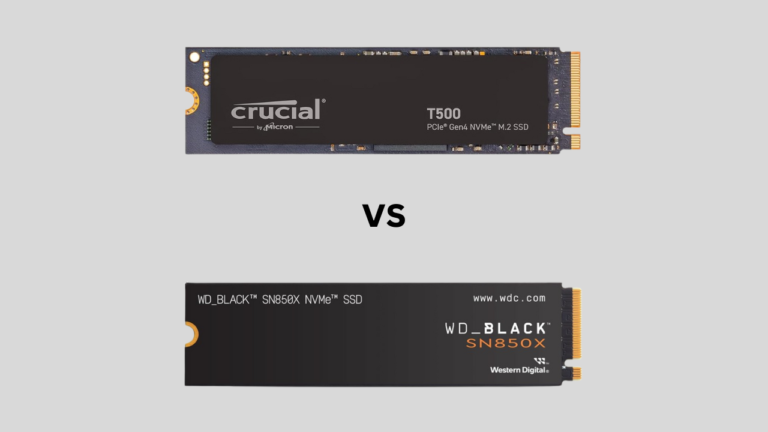
WD Black SN770 and SN850X compete in different Gen 4.0 NVMe categories. The SN770 is a mid-range drive, while the SN850X targets the high-end market. The SN770 is priced aggressively, with clear cost-cutting, including a DRAM-less design. However, the SN850X is comparatively expensive with some extra features compared to the SN770.
Both SSDs, except the 8TB variants of the SN850X, use the same Kioxia BiCS5 TLC NAND Flash. The 8TB SN850X has the BiCS6 NAND with more layers. The G2 controller (Triton MP16+ B in 8TB) in the SN850X wins on performance and sustained throughput, while the Polaris MP16+ in the SN770 is designed to be efficient.
The SN850X supports TCG Opal encryption, while the SN770 lacks any encryption. Encryption protects data; if the device is lost or stolen, it is a good feature to have.
The 250GB and 500GB variants of the SN770 can be good options for systems with limited storage requirements. However, it lacks the 4TB or 8TB variants that the SN850X offers for the capacity-conscious buyers. All in all, both SSDs have their own pros and cons, but feature-wise, the SN850X is much better and hence offers better performance. But the SN770 saves you some money.

So, let’s see how much performance improvement you actually get and whether the extra money for the SN850X is worth it.
Theoretical Specifications
| Specification | WD Black SN770 | WD Black SN850X |
|---|---|---|
| PCIe Generation/NVMe Version | PCIe Gen 4.0 x4 / NVMe 1.4 | PCIe Gen 4.0 x4 / NVMe 1.4 |
| Release Date | February 2022 | August 2022 |
| Capacities | 250GB, 500GB, 1TB, 2TB | 1TB, 2TB, 4TB, 8TB |
| Sequential Read Speed | 250GB: 4,000 MB/s 500GB: 5,000 MB/s 1TB: 5,150 MB/s 2TB: 5,150 MB/s | 1TB-4TB: 7,300 MB/s 8TB: 7,200 MB/s |
| Sequential Write Speed | 250GB: 2,000 MB/s 500GB: 4,000 MB/s 1TB: 4,900 MB/s 2TB: 4,850 MB/s | 1TB: 6,300 MB/s 2TB-4TB: 6,600 MB/s 8TB: 6,600 MB/s |
| Random Read Speed | 250GB: 240K IOPS 500GB: 460K IOPS 1TB: 740K IOPS 2TB: 650K IOPS | 1TB: 800K IOPS 2TB-8TB: 1,200K IOPS |
| Random Write Speed | 250GB: 470K IOPS 500GB-2TB: 800K IOPS | All capacities: 1,100K IOPS |
| NAND Flash | Kioxia BiCS5 TLC (112-layer) | Kioxia BiCS5 TLC (112-layer) |
| DRAM | No (HMB) | Yes (DDR4) |
| Controller | WD Polaris MP16+ | WD Black G2 |
| Price (MSRP) | 1TB starting from 75.99$ | 1TB starting from 96.99$ |
The WD Black SN850X clearly targets the high-end segment with its 8-channel controller, onboard DDR4 DRAM, and significantly higher sequential speeds that approach the theoretical limits of PCIe 4.0 bandwidth. The drive achieves sequential read speeds of up to 7,300 MB/s and write speeds of up to 6,600 MB/s, representing approximately 42% faster reads and 35% faster writes than the SN770’s peak specifications.
The SN770, by contrast, employs a more cost-effective design philosophy. It uses a 4-channel controller and lacks onboard DRAM, instead relying on Host Memory Buffer (HMB) technology. It can borrow up to 64MB of system RAM for mapping table storage. This DRAM-less architecture typically comes with performance drawbacks, mainly in sustained workloads and scenarios with numerous small-file operations.
Benchmark Scores Comparison
All the benchmark scores are for the 2TB variants of both drives.
PCMark 10 Full System Drive Benchmark
The PCMark 10 Full System Drive Benchmark simulates everyday computing tasks, including Windows boot sequences, application launches, file transfers, and productivity workflows. This test provides the most accurate representation of how these drives will perform during typical daily usage patterns.

The SN850X is a little faster in all these score types. The PCMark 10 overall score goes from 3962 to 4063 (~2.5%), bandwidth increases from 689 to 645 MB/s (~6% faster), and latency improves from 46 µs to 41 µs (~+11% lower). Overall, the SN850X is slightly quicker and more responsive, but the real-world difference will be negligible unless you’re hammering the drive with heavy workloads.
3DMark Storage Test for Gamers
The 3DMark Storage Benchmark focuses specifically on gaming-related storage operations, including game launches, level loading, save file operations, game installations, and video recording scenarios. This benchmark better reflects the demands placed on storage during actual gaming sessions than synthetic sequential tests do.

The SN850X scores 4572 in 3DMark, compared to the SN770’s 3516. This means a significant difference in gaming performance. The bandwidth is higher again from the SN850X (778 vs 566 MB/s). The latency in SN850X is 39 microseconds, while the SN770 has 48 microseconds. Overall, the SN850X will deliver a way better gaming performance than the SN770.
CrystalDiskMark Peak Sequential Performance
For the CDM Sequential benchmark, we used 1 MiB data blocks at queue depths of 1 and 8, respectively.

The WD Black SN850X (2TB) is clearly faster in the 1MB QD8 tests, with a read speed of 6,982 MB/s compared to the SN770’s 4,874 MB/s, and a write speed that’s also about 37% higher. In the 1MB QD1 read test, both drives are almost identical, but the SN850X still leads by around 20% in the write test. Overall, the SN850X is better for heavier tasks like large file transfers or content creation, while the SN770 is good enough for regular use and gaming.
CrystalDiskMark Random Read/Write Performance
For the CDM peak random read/write IOPS benchmarks, we have selected 4KB data blocks at the queue depths of 1 and 256.

In the 4KB QD1 tests, the SN850X reads slightly faster at 22,853 IOPS versus 19,929 on the SN770, though it falls a bit behind in writes. The real gap shows up in high-queue workloads: at QD256, the SN850X nearly doubles the SN770’s read performance and delivers about 52% higher write speeds. That makes the SN850X far better for handling heavy multitasking, database work, or server-like loads. At the same time, the SN770 is still a solid performer for everyday desktop or gaming use, where those massive queue depths don’t really come into play.
File Transfer Rate

The SN850 edges out the SN770 across the board here. Its copy speed is around 23% faster, and it maintains a clear lead in both read and write transfers. The difference isn’t massive, but it’s noticeable when moving large files or working with compressed archives. For quick data transfers or handling big projects, the SN850 is the better pick, while the SN770 still offers substantial value for regular daily use or gaming setups.
Power Consumption and Efficiency

Both drives are close in efficiency, with the SN850X holding a tiny edge at 449 MB/s per watt versus 445 on the SN770. However, that efficiency comes with a higher power draw. The SN850X uses more power on average and peaks at 7W compared to the SN770’s 5W. Idle power is also a bit higher. In short, the SN770 is the better option for energy-conscious or laptop users, while the SN850X makes sense for desktops or performance setups where a bit more power use is no concern.
TBW, DWPD, MTBF, and Warranty
| Specification | WD Black SN770 | WD Black SN850X |
|---|---|---|
| Endurance (TBW) | 250GB: 150 TBW 500GB: 300 TBW 1TB: 600 TBW 2TB: 1,200 TBW | 1TB: 600 TBW 2TB: 1,200 TBW 4TB: 2,400 TBW 8TB: 4,800 TBW |
| Warranty | 5 Years | 5 Years |
| DWPD | 0.3 | 0.3 |
| MTBF | 1.8 Million Hours | 1.8 Million Hours |
The matching variants of both drives, i.e., 1TB and 2TB, have the same TBW ratings. Other variants also have the TBW that we generally get in the market. The warranty periods, DWPD, and MTBF are also the same and are pretty decent. So, there is nothing to compare here but both drives are good in terms of reliability and endurance.
Technical Specifications
| Specification | WD Black SN770 | WD Black SN850X |
|---|---|---|
| Controller | WD 20-82-10081-A1 Polaris MP16+ | WD G2 in 1TB, 2TB, and 4TB variants WD Triton MP16+ B2 in 8TB variant |
| Controller Architecture | ARM 32-bit Cortex-R | ARM 32-bit Cortex-R |
| Process | 16 nm | 16 nm |
| DRAM Specifications | None (HMB) | 1TB: 1024 MB (DDR4) 2TB: 2048 MB (DDR4-3200) 4TB: 2048 MB (DDR4-3200 CL22) 8TB: 2048 MB (DDR4-3200 CL22) |
| SLC Write Cache | 250GB: – 500GB: – 1TB: approx. 377 GB (dynamic only) 2TB: approx. 740 GB(dynamic only) | 1TB: approx. 300 GB(288 GB Dynamic + 12 GB Static) 2TB: approx. 600 GB(576 GB Dynamic + 24 GB Static) 4TB: – 8TB: approx. 2350 GB |
| NAND Flash | BiCS5 TLC 3D NAND (112-layer) | BiCS5 TLC 3D NAND (112-layer) BiCS6 TLC 3D NAND in 8TB (162-layer) |
| NAND speed | 1,200 MT/s | 1,200 MT/s |
| Encryption | None | TCG Opal |
| SMART/TRIM/PS5 Support | Yes/Yes/Yes | Yes/Yes/Yes |
| Heatsink Variant | Not Available | Available |
| Datasheet | SN770 | SN850X |
The WD Black SN770 and SN850X share the same 16 nm process and controller class, but they sit in very different leagues. The SN770 is a DRAM-less, value-oriented drive that leans on Host Memory Buffer and BiCS5 TLC NAND to deliver respectable PCIe 4.0 speeds. Still, it’ll choke under sustained heavy writes or professional workloads.
The SN850X, meanwhile, is the flagship: full DRAM cache, higher endurance, optional TCG Opal encryption, and faster firmware pushing up to 7.3 GB/s. It’s built for people who actually stress their storage, including content creators, enthusiasts, or anyone wanting top-tier consistency. In short, the SN770 is a solid budget performer, which will save you money, but the SN850X is the no-compromise Gen 4.0 powerhouse.
Price
By the time I am writing this article, the 1TB variant of the SN770 is available for 85.99$ while the 1TB SN850X is selling for 109.99$ on the official website. The same goes for the 2TB variants. The 2TB SN770 is priced at 129.99$ while the 2TB SN850X is available for 169.99$. Overall, you will save a good amount of money by choosing the SN770 while compromising on one or two specifications. However, prices keep changing, so you must compare them across different marketplaces before making a final decision.
Conclusion: Which One Should You Choose?
WD Black SN850X is best for those who want the confidence of a DRAM SSD with strong sustained performance. You will have to pay a little extra for the DRAM, Game Mode, and encryption, mainly. Most other specifications are similar. In the benchmarks, the SN850X beats the SN770 in most tests, but not by huge margins. So, in day-to-day use, you are hardly missing anything by going with the SN770.
Depending on how much you save, the SN770 can be a good pick because, as we discussed earlier, HMB has advanced, and we hardly notice any issues in most tasks on our computers. So, for most normal users, including hobbyist gamers and even content creators, the SN770 will give a similar performance while saving some money. But if you want the best gaming performance with a dedicated game mode and DRAM that helps with certain demanding tasks, you should pick the SN850X for sure.